The Game That Builds Itself Around You
A browser game I built to present my WRIT 340 article on generative AI in games.
What it is
A browser game I built to present my WRIT 340 article on generative AI in games. You explore a coastal town while demonstrations explain character memory, interactive objects, and choices that change the world. The AI examples are scripted; no AI model runs in the game.
The game runs in eight short chapters, and slides built into it open at each checkpoint, so it doubles as the deck for my class presentation.
Highlights
The opening still: in Chapter 7, the player and Mara stand at the edge of a collapsed stone bridge at dusk, with the lighthouse island across the water.
What’s real
Every line of dialogue is written in advance, and the learned-generation and 3D-car examples are prepared demonstrations, labeled as simulations on screen. The rest is computed as you play: a seeded generator builds and checks town maps, Mara ranks her memories by recency, importance, and relevance, and your choices change routes, characters, and objectives for the rest of the run.
The pixel art is drawn in code on an HTML canvas. I designed and wrote the game, and built it with help from AI coding tools.
The ideas it demonstrates
Procedural and learned generation
A rule-based generator builds a new town map from a seed and checks it against three rules. Beside it, a prepared example shows what generating a place from a description might look like.
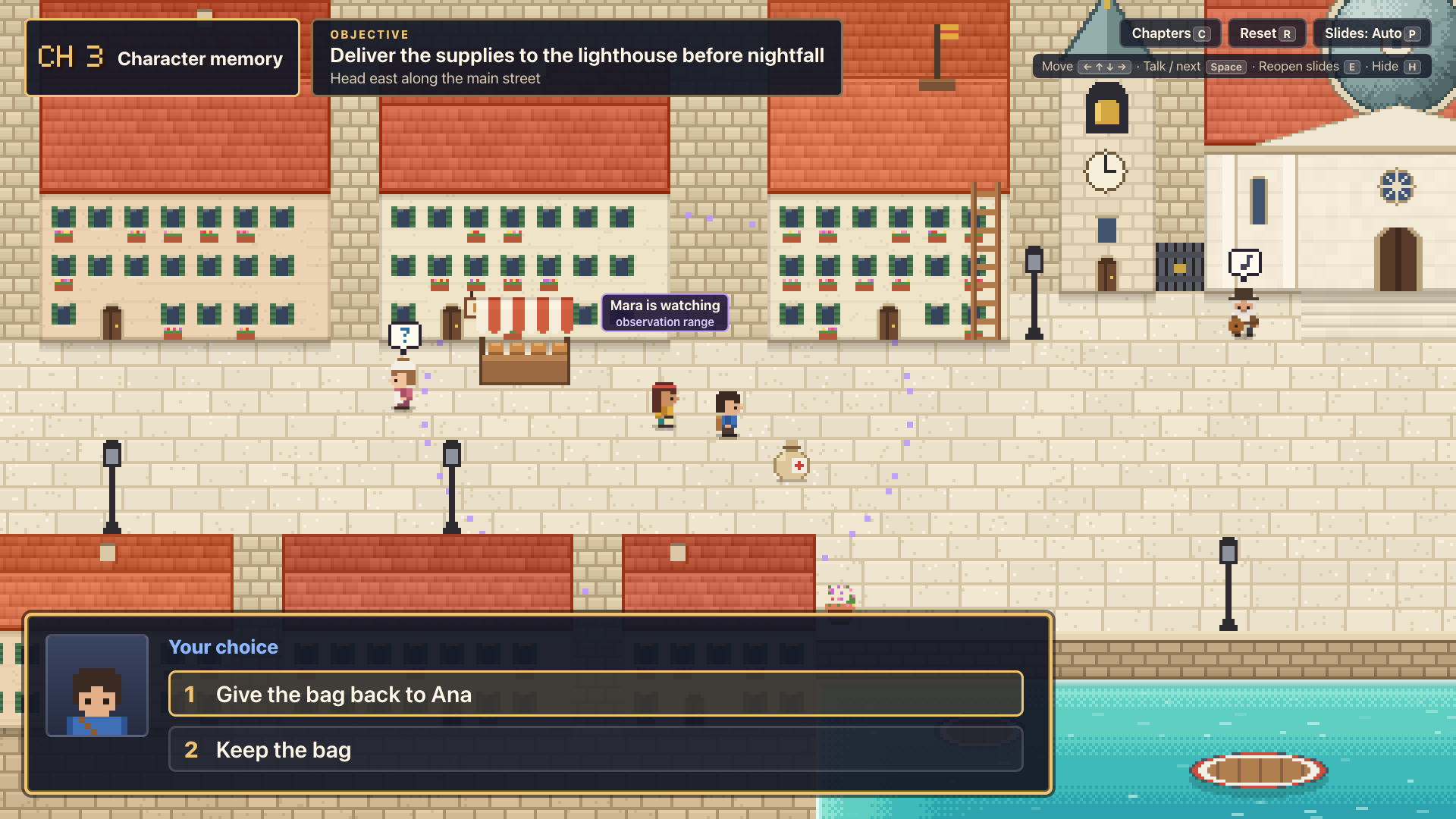
Character memory
Mara stores what she sees and recalls what fits the moment, ranked the way the Generative Agents research describes.
From dialogue to action
Agreeing to help isn’t enough. A request only works once it connects to a place, a route, and an action the game supports.
A car that works
A car arrives in four stages, appearance, geometry, parts, and behavior, and you can only drive it after the last one.
Lasting consequences
If the bridge collapses, merchants reroute, the way back becomes the ferry, and characters remember what happened.
Agency and authorship
The last chapter uses the MDA framework (mechanics, dynamics, aesthetics) to ask who shapes a playthrough: the developer, the generative system, or the player.
Full playthrough
The title screen: “The Game That Builds Itself Around You” in pixel lettering over the town, labeled a scripted demonstration of generative AI concepts.