Argentina · Education & social mobility
The Geography of Opportunity in Argentina
Understanding how education can expand opportunity in the communities that shaped my family.
A personal research project on education and social mobility in Argentina, rooted in my family’s connection to 9 de Julio. Conducted through USC Marshall’s BUAD 490 Directed Research with Professor Diego Daruich.
- Research in progress · Fall 2026
- USC Marshall · BUAD 490
- Author
- Ben Llados
- Faculty supervisor
- Professor Diego Daruich (opens in a new tab)
- Course
- BUAD 490 Directed Research, USC Marshall
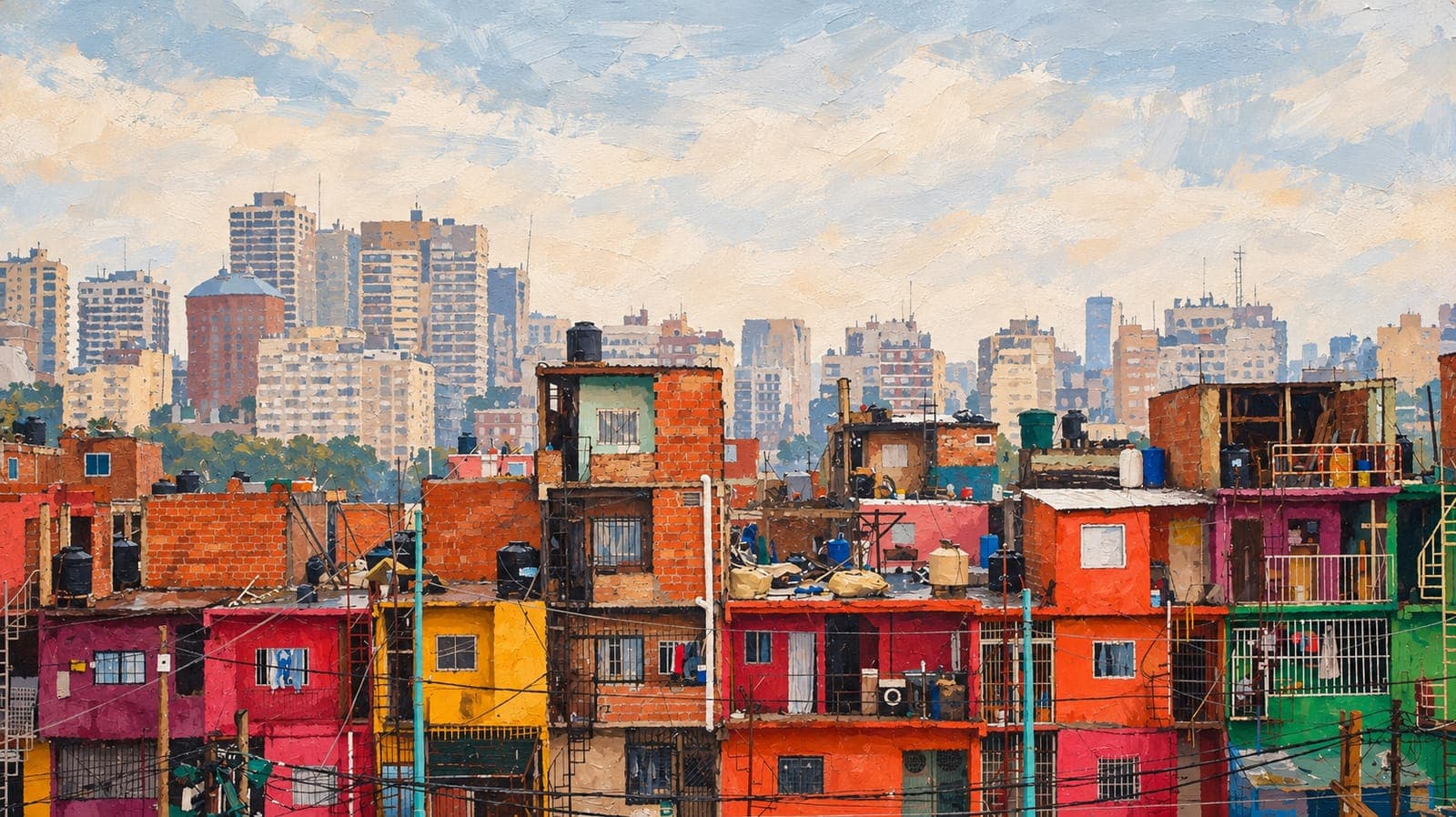
Painted view of Villa 31, Buenos Aires.
My mom grew up in 9 de Julio, a place that means a great deal to my family. She was one of the few among her friends who moved away, building her path through education, taking risks, and working multiple jobs. Her story is a big part of why I care about the opportunities available to young people in smaller Argentine communities.
We return every year, and over time I’ve built friendships that make these questions deeply personal. I want to understand how education shapes my friends’ possibilities, what helps people pursue their ambitions, and what allows a smaller community to create opportunities for the next generation.
My long-term mission is to help underserved communities in Argentina gain more resources, influence, and choices over their futures.
This research is an early step toward understanding where I might contribute.
The question
How do education and early-career opportunities differ between smaller Argentine communities and major urban centers, and what helps a smaller city become a place where young people can thrive?
I’m examining educational attainment, employment, access to registered work, earnings, and job stability among young adults ages 18 to 29. I’m especially interested in how people with similar education experience different opportunities depending on their local labor market.
The research
I’m conducting this project through BUAD 490 Directed Research at USC Marshall, which provides a framework for independent research under faculty supervision.
My supervisor is Professor Diego Daruich (opens in a new tab), Assistant Professor of Finance and Business Economics. His work on education, human capital, and labor economics connects closely to the questions guiding this project.
The analysis has two parts:
Urban labor-market comparisons
Using Argentina’s Permanent Household Survey, or EPH, to examine education and employment outcomes across smaller and larger surveyed urban areas.
A separate 9 de Julio case study
Using Census 2022 and employment data from the Observatorio de Empleo y Dinámica Empresarial (OEDE) to understand the local context, while evaluating school data and potential interviews as additional sources.
This distinction matters: EPH does not directly identify 9 de Julio or represent all rural Argentina. The analysis examines patterns and relationships; it does not by itself establish that location causes a particular outcome.
What I’m working toward
The project is currently focused on preparing data and developing the first comparisons. The intended output is a research paper and presentation, with findings shared here as the analysis develops.
Ultimately, I want this work to help me understand how communities like 9 de Julio can give young people more power to build meaningful futures, whether they choose to stay, leave, or return.
Back to Writing